If you’re about to start transcranial magnetic stimulation (TMS), it’s natural to wonder what it will be like. The good news is that TMS is non-invasive and needs no anesthesia or sedation. You stay fully awake and alert the whole time, and most people go straight back to their normal day afterward.
Here’s what to expect, step by step.
When you arrive
You’ll settle into a comfortable chair. A soft cap is placed on your head so your treatment spot can be marked precisely, and you’ll be given earplugs or headphones to wear.
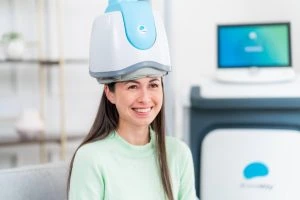
The magnetic coil is then positioned gently against your scalp. We use a helmet shaped coil (H coil) with a chin strap. From there, you can relax, listen to music, or simply rest. There’s nothing you need to do during the session.
What TMS feels like
Most people notice two sensations: sound and touch.
Sound. The machine makes a repeated clicking noise with each magnetic pulse. That’s why the earplugs matter.
Touch. On your scalp, you’ll feel a light tapping or knocking sensation. It comes in short bursts with rest periods in between.
Some people also feel a slight twitch in the muscles of the scalp or face, or a mild tightening near the forehead, jaw, or around the eye. This is normal and isn’t a sign that anything is wrong.
Your first session: finding the right strength
At your very first session, your care team measures how your muscles respond to the magnetic pulses. This lets them set the treatment strength that’s right for you. During this part, you may see your hand or fingers twitch. That’s completely normal and expected.
If the tapping feels too strong at first, just tell your technician. They can start at a lower level and gradually increase it as you get used to it, adjust the coil position, or add extra head support. You’re always in control of speaking up.
How long does TMS take?
Depending on the type of TMS protocol, a single session can last anywhere from a few minutes to about half an hour. A full course is usually done once a day, five days a week, over several weeks. Your clinician will walk you through the schedule that fits your treatment plan.
Is TMS uncomfortable? Side effects to know about
Most people find TMS very tolerable, and any discomfort usually fades within the first week or two as you get used to the sensation.
The most common side effects are mild and temporary:
- A headache or scalp tenderness during or shortly after a session. This generally eases on its own and can be helped with an ordinary over-the-counter pain reliever if needed.
- Mild facial or scalp muscle twitching during treatment, which stops when the session ends.
Serious side effects, such as a seizure, are very rare.
After your session
Because you aren’t sedated, you can drive yourself and return to work, errands, or your normal routine right afterward. Some people like to have someone drive them home after the very first visit, just until they know how they’ll feel.
Always let your treatment team know about any discomfort, new symptoms, or concerns. Small adjustments can make each session more comfortable, and your clinician will check in with you regularly to track how you’re doing.
Quick answers to common questions
Does TMS hurt? Most people describe it as tapping rather than pain. Any discomfort is usually mild and tends to fade within the first week or two.
Will I be put to sleep? No. TMS requires no anesthesia or sedation. You stay awake and alert throughout.
Is TMS the same as ECT (shock therapy)? No. TMS uses magnetic pulses targeted at a specific area of the brain. It doesn’t cause a seizure, doesn’t require anesthesia, and doesn’t affect memory the way ECT can.
Can I drive after TMS? Yes. You can drive yourself and return to your day right after each session.
Have questions about TMS?
If you’re considering TMS or about to start, our team at Empower Psychiatry & Sleep is happy to answer your questions. We provide TMS therapy for patients across Johns Creek, Suwanee, Cumming, and the North Metro Atlanta area. Call (770) 615-0226 or contact us to learn whether TMS may be right for you.
This article is for general educational purposes and is not a substitute for personalized medical advice. Please talk with your healthcare provider about your individual situation.
START YOUR JOURNEY
CONTACT US!
Complete this form so we can assist with your mental health journey.